
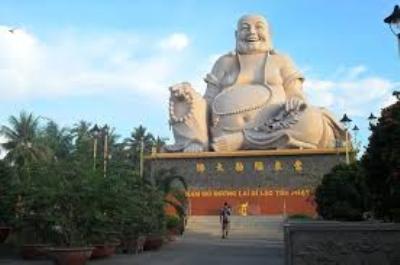
It is a well-known fact that laughter is therapeutic and as well contagious too! I have always thought about the Laughing Buddha and I have always loved his pictures too. After seeing the picture of the Laughing Buddha inside a Lotus Flower—shirtless I was full of wonders!! And guess what? The smile/laughter of the Laughing Buddha really made me smile/laugh! Suffice that it lifted my vibration. I kept smiling thinking about the Laughing Buddha and I began to love and admire the Laughing Buddha! Lol…so I decided to make a research about the Laughing Buddha and I found some lovely information about this amazing and Laughing Buddha which I will share with you; but before I will go ahead and share these information with you, here is what happened as I was researching about the Laughing Buddha:
While I was reading about the Laughing Buddha; I saw a line where he was described as “poor…” in my mind I said with levity and intuitively “this is not true because the Laughing Buddha represents opulence after all he does not look poor. He must have been camouflaging simplicity and low-key…” to my greatest surprise I read the next line describing the Laughing Buddha as symbolizing abundance and contentment; something I have firsthand intuitively realized!
So without further ado, here are the information about the Laughing Buddha I hope the Laughing Buddha causes you to smile!

Laughing Buddha statues are perhaps one of the most loved artefacts. They are commonly seen in homes, offices, hotels, gardens, restaurants, shops, and museums and temples. They are made of wood, metal, porcelain, and stone or painted in colour and line.
The Laughing Buddha is a symbol of happiness, contentment and prosperity. He is called ‘Budai’ in Chinese. Figures of the Laughing Buddha at the Salar Jung Museum are popular with the visitors.
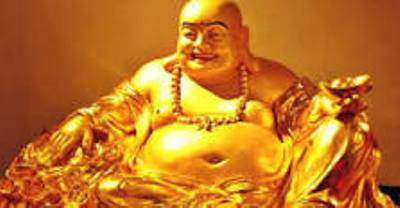
The Laughing Buddha is a symbol of happiness, contentment and prosperity. He is called ‘Budai’ in Chinese. Figures of the Laughing Buddha at the Salar Jung Museum are popular with the visitors.
According to Chinese tradition, ‘Budai’ was an eccentric Chinese Zen monk who lived during the later Liang dynasty (907-923 AD) of China. He was a native of Fenghua and his Buddhist name was Qieci (Chinese : Pinyin). He was considered a man of good and loving character. Some Buddhist traditions consider him a Buddha or ‘Bodhisattva’, usually Maitreya (the future Buddha). His large protruding stomach and jolly smile have given him the common designation “Laughing Buddha”.
In Japanese, ‘Budai’ is pronounced as ‘Hotei’. It means ‘clothsack’ or ‘glutton’. It is believed that if one rubs the belly of Buddha, it brings good luck and wealth. The Laughing Buddha is also seen as one of the seven Japanese Shinto Gods of luck.
In Thailand, ‘Budai’ is sometimes confused with a widely-respected monk, ‘Sangkachai’. ‘Sangkachai’ was a Budhist ‘Arhat’ (Arahant in ‘Pali’) during the time of Lord Buddha. Lord Buddha praised Angkachai for his excellence in explaining Dharma easily and correctly.
He was one of the Eighteen ‘Arhats’ of Buddhism.
However, two points distinguish ‘Sangkachai’ from ‘Budai’.
While Sangkachai has a trace of hair on his head, ‘Budai’ is clearly bald. And while ‘Budai’ covers both arms and leaves the torso uncovered, Sangkachai wears robes folded across one shoulder.
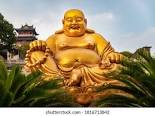
Chinese temples have figures of the Laughing Buddha located at temple entrances. He is often worshipped as a God of good luck and prosperity.
The Lingyin temple in Hangchou has a Laughing Buddha carved out of camphor wood, over 60-feet tall and gilded with one hundred ounces of gold leaf. The Lama temple in Beijing has the largest Laughing Buddha, which is carved from a single piece of wood.
Taiwan’s Treasure Cognition temple at Taichung houses the country’s largest Laughing Buddha, with his bald head touching the ceiling.
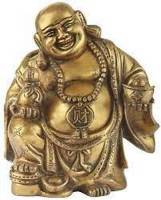
Called ‘Fat Buddha’ in English-speaking countries, ‘Hasne Buddha’ in Nepalese, the Laughing Buddha is all about blurring the cultural divide between West and East as he brings good luck to all.
An account exists of the post mortem appearances of Budai, the Laughing Buddha, recorded in the Ching-te ch’uan-teng-lu (The Transmission of the Lamp), written between 1004 and 1007 CE by the monk Shi Daoyuan.
“In the third month of the third year of Cheng Ming (917 AD), the Master proclaimed his approaching parinirvana. At the Yueh-lin Temple, he took up his seat, cross legged, on a flat stone below the Eastern veranda, and spoke the following verse:
“Maitreya, the Veritable Maitreya, divides his body into ten thousand million parts. From time to time, appearing among men, he proclaims the Truth to the men of that era, but they naturally do not recognise him.”
Budai has origins centered around cult worship and local legend.[6] He is traditionally depicted as a fat, bald monk wearing a simple robe. He carries his few possessions in a cloth sack, being poor but content.[7] He would excitingly entertain the adoring children that followed him and was known for patting his large belly happily. His figure appears throughout Chinese culture as a representation of both contentment and abundance. Budai attracted the townspeople around him as he was able to predict people’s fortunes and even weather patterns.[5] The wandering monk was often inclined to sleep anywhere he came to, even outside, for his mystical powers could ward off the bitter colds of snow and his body was left unaffected. A recovered death note dated to 916 or 917 A.D., which the monk himself wrote, claims that he is an incarnation of Maitreya, the Buddha of the Future.
When he had finished reciting this verse, he quietly died. Afterwards, there were men in his neighbourhood who saw the Master, carrying his bag as before and walking. Because of this, the monks vied with one another in painting his likeness. Now in the Yueh-lin Temple, in the Eastern part of the Great Hall, is preserved his body (embalmed), and people in many places speak of his re-apparition as a proven fact.”
(Source: https://en.wikipedia.org/wiki/Budai)
 Kingsley Osajie
Is it gilded or girded
LikeLike
It would have been better for you to clarify what you mean
LikeLike