
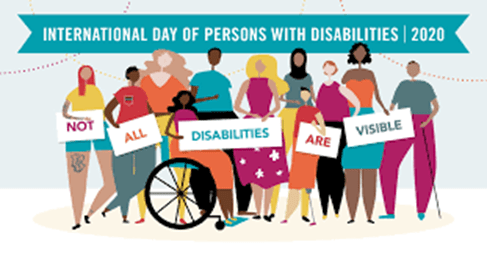
People with disabilities have historically faced barriers to employment that limit their potential and prevent them from participating in the workforce. They are often viewed as objects of charity or as lacking the skills necessary to compete for jobs. However, people with disabilities have a valuable perspective and benefits that can contribute to a companies growth.
In today’s world, especially in Africa where unemployment rate is rare and difficult to see people with disabilities having a maximum and optimal inclusion in the labour force. With such menace; it is very pertinent to push for the inclusion of people with disabilities into the employment processes as they have been well marginalized. It must be pointed out also that the disabled—in them lies a great wealth of potential and talent yet to be tapped and unlocked. For this reason, giving them access and promote in the employment process can never be overemphasized!
According to The Understood Team, “Disability inclusion at work is about more than hiring people with disabilities. An inclusive workplace values all employees for their strengths. It offers employees with disabilities— whether visible or invisible—an equal opportunity to succeed, to learn, to be compensated fairly, and to advance. True inclusion is about embracing difference.”
Why Disability Inclusion?
Disability inclusion is also crucial to your hiring process. If candidates face barriers during the application and interview process, or if they sense that your business is not inclusive, they’re likely to look elsewhere. Companies with strong disability inclusion programs have better access to talent and better employee retention. They have the tools they need to help their employees thrive.
Everybody gains from disability inclusion
For the one billion women and men with disabilities, inclusion in the labour market, and in society requires the breaking down of existing barriers. By including people with disabilities, companies, individuals and society at large all win.
The benefits of inclusive workplaces
Access to talent
By focusing on skills rather than stereotypes, you access an untapped pool of talent.
Increased innovation
Employees with diverse experiences have different approaches to problem solving.
Increased engagement and retention
Employees who feel included have higher levels of loyalty and enthusiasm.
Better reputation
Customers value companies that show a real commitment towards inclusion.
The Maternal Law Group has pointed out employers’ obligations towards People with Disabilities; which are:
- Employers must provide reasonable accommodations to employees with disabilities to perform the essential functions of their job.
- Employers must treat people with disabilities fairly throughout the selection process, during employment, and when they remove them.
- Employers may not engage in any conduct that creates a hostile work environment, such as offensive jokes or teasing.
Creating a Disability-Inclusive Workplace
To create a successful disability-inclusive workplace, employers should start by:
- Educating their workforce. Hiring and training people with disabilities are not enough if the rest of the employees do not know how to interact or adapt to the new work environment.
- Communication about accommodating individuals with disabilities should be transparent, and all employees should be involved in the process. It’s crucial to recognize that there is no one-size-fits-all approach.
- Companies may need to make changes to their physical environment, such as parking spots or entrance ramps, or adopt new technological applications, videos, or sign language interpreters.
Creating a disability-inclusive workplace is more than just complying with legal reforms. It is an opportunity for employers to tap into a diverse, talented workforce that benefits everyone. When employers create a culture of inclusion, they are sending a message that everyone has value. Businesses that intentionally embrace inclusivity not only benefit from diverse perspectives and talents but also contribute to positive societal change. Hiring people with disabilities not only helps them achieve better economic independence and quality of life but also builds a more inclusive and equitable workforce overall.
I was at the Oxfam Office in Maitama Abuja for a conference with People with Disabilities. A lady who is among the physically challenged persons made some profound points which I am sharing below:
According to her over 31,000,000 (thirty-one million) people are living with disability in Nigeria. She mentioned the interventions that could further help to ameliorate the reality being experienced by the PWDs to include:
- Tools to be accessible to the disabled people. The first step is to include persons with disabilities in the affairs of the nation. She commended Oxfam for including people living with disabilities in their meeting at the same time emphasized that disability is never homogenous.
- Qualified and educated women/people with disabilities should be given meaningful positions in the government as they will be in a better space to speak and represent the PWDs. Using herself as an example, she cited that her multi-lingual ability has helped to reach the hearts of the PWDs in remote/rural areas as she is able to speak Hausa, Yoruba and Igbo very fluently. According to her when she is in the northern part of Nigeria for campaign she speaks the Hausa language, when she is in the western part of Nigeria for campaign she speak Yoruba language and when she is in the Eastern part of Nigeria for campaign she speaks the Igbo language. She also cited an example where she was in a market in Oyo state for campaign. According to her, as soon as she began speaking the Yoruba language she was surrounded by all the market women as that drew their attention making it possible to reach the heart of those women and had a very successful campaign there in Oyo state.
- Quality services in terms of sustainable shelters/welfare and accessibility to the services even if it means giving stipends to the PWDS to enable them transport themselves to the places where the necessary facilities they need are located.
- Health needs. Provision of affordable (and even free) medical care for the PWDs.
- Training of people without disabilities. She maintained that their organization train people without disabilities which make them serve as advocate and voice for the people living with disabilities.
- Contextualization to suit the needs of the PWD. She mentioned that environmental factors and cultural differences matters because what works in the northern part of Nigeria might not work in the southern part of Nigeria and what works in the southern part of Nigeria might not work in the eastern part of Nigeria and same thing to the western part of Nigeria as well. She encouraged a renewed and upgraded mode of operation.
 Kingsley Osajie